
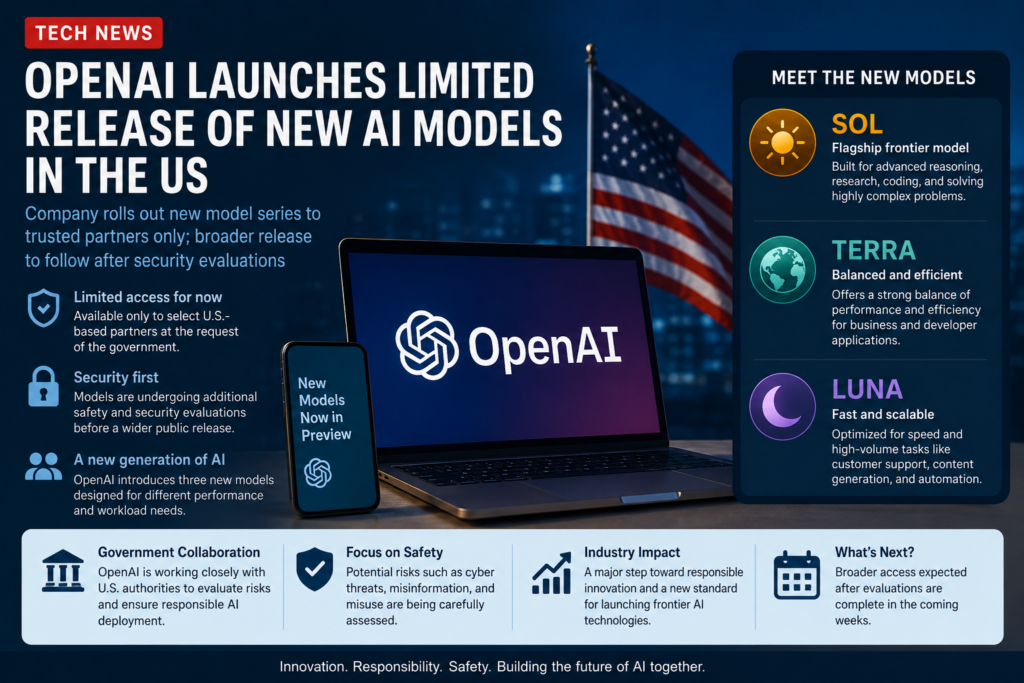
OpenAI has officially begun the limited rollout of its newest generation of artificial intelligence models in the United States, marking another significant milestone in the rapidly evolving AI industry. Unlike previous launches that were immediately available to millions of users worldwide, this release is being introduced cautiously, with access restricted to a small group of trusted organizations and partners.
The company confirmed that the decision to limit availability was made in coordination with the U.S. government, which requested additional security assessments before the models become widely accessible. The move reflects growing concerns among policymakers about the capabilities of frontier AI systems and the potential risks they could pose if released without sufficient safeguards.
A New Generation of AI Models
The latest AI family includes three distinct models—Sol, Terra, and Luna—each designed to serve different user needs.
Sol is OpenAI’s flagship model, built for advanced reasoning, scientific research, software development, and solving highly complex tasks. It represents the company’s most powerful AI system to date and is expected to compete with the most capable models developed by rival AI companies.
Terra focuses on balancing performance with cost efficiency. It is intended for businesses and developers who require strong AI capabilities without the higher computational demands of premium models.
Luna, meanwhile, is optimized for speed and affordability, making it suitable for customer support, content generation, workflow automation, and other high-volume applications.
By offering multiple models, OpenAI aims to provide flexible AI solutions for startups, enterprises, researchers, and developers with varying requirements.
Why Is the Release Limited?
Unlike traditional software launches, frontier AI models have become a matter of national security and public policy.
According to reports, the U.S. government requested early access to evaluate the models for potential cybersecurity vulnerabilities, misuse scenarios, and broader societal risks before they are released to the general public.
Government agencies are particularly interested in understanding whether advanced AI systems could be exploited to generate sophisticated cyberattacks, assist in creating dangerous biological or chemical information, spread misinformation at scale, or support other malicious activities.
OpenAI has emphasized that it supports responsible AI deployment and believes additional testing will help ensure safer adoption of increasingly capable AI technologies.
Growing Government Oversight
The limited rollout highlights a broader trend in AI regulation.
Over the past two years, governments worldwide have become increasingly involved in monitoring the development of advanced AI systems. As these models become more powerful, policymakers are introducing stricter evaluation frameworks aimed at balancing innovation with public safety.
Rather than regulating AI only after problems emerge, authorities are beginning to work directly with technology companies during the development and release process.
This collaborative approach represents a significant shift in how cutting-edge technologies are introduced to the public.
Industry Reaction
The announcement has generated considerable attention across the technology industry.
Many AI researchers have welcomed the cautious rollout, arguing that advanced AI systems deserve extensive testing before becoming widely available.
Others believe that delaying public access could slow innovation and reduce opportunities for developers and businesses eager to build products using the latest AI capabilities.
Technology companies competing in the AI race—including Google, Anthropic, Meta, and xAI—are closely watching OpenAI’s approach, as it could establish new industry standards for launching frontier AI models.
What This Means for Businesses
Although access remains limited, businesses should prepare for broader availability in the near future.
Organizations are expected to benefit from improved reasoning, more accurate responses, stronger coding assistance, faster automation, and better support for complex enterprise workflows.
Industries such as healthcare, finance, education, legal services, manufacturing, and customer support are likely to experience increased AI adoption as these advanced models become more widely accessible.
Companies investing in AI today may gain significant productivity advantages once the new models are released globally.
The Future of AI Deployment
The phased release signals a new era in artificial intelligence development.
Instead of launching increasingly powerful AI systems without restrictions, technology companies are moving toward staged deployments that include government reviews, safety testing, and continuous monitoring.
This approach may become the standard for future frontier AI releases as regulators, researchers, and technology companies work together to ensure innovation progresses responsibly.
While OpenAI has not announced an exact timeline for expanding access beyond the United States, the company has indicated that broader availability could follow after ongoing evaluations are completed.
For now, the limited release serves as both a technological milestone and a reminder that the future of artificial intelligence will be shaped not only by innovation but also by responsible governance, transparency, and public trust.
As AI continues transforming industries and everyday life, decisions made during launches like this could influence how advanced technologies are developed, regulated, and adopted worldwide for years to come.