


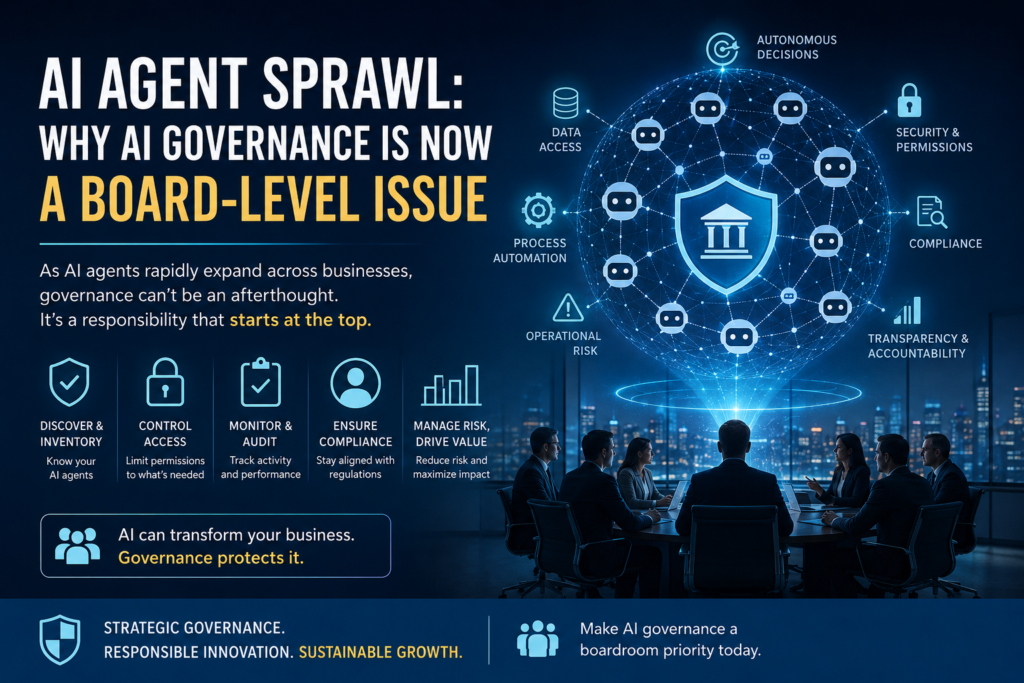
AI is moving from experimentation to execution — and businesses now need to think beyond adoption.
Artificial intelligence is rapidly changing how companies operate. The latest development is the rise of Agentic AI — AI systems that can do more than generate content or answer questions. AI agents can interact with systems, access information, execute tasks and support business processes with increasing levels of autonomy.
But as organisations deploy more AI agents, a new challenge is emerging: How do companies control, monitor and govern these AI systems?
The Rise of AI Agent Sprawl
According to a recent SAP analysis, 98% of companies surveyed have already deployed AI agents or plan to do so. At the same time, fewer than half of organisations surveyed have sufficient visibility into their AI-agent inventory.
This creates what is increasingly being called “AI agent sprawl.”
AI agent sprawl occurs when organisations create and deploy numerous AI agents across different departments and systems without a centralised framework for:
- Ownership
- Access permissions
- Security
- Monitoring
- Compliance
- Risk management
- Performance evaluation
- Retirement of outdated agents
As businesses accelerate AI adoption, managing these systems could become as important as managing traditional IT infrastructure.
AI Agents Are Becoming More Autonomous
Traditional generative AI primarily assisted employees with tasks such as:
Writing → Summarising → Research → Content Creation
Agentic AI takes this further:
Understanding → Planning → Executing → Monitoring → Escalating
For example, an AI agent could potentially:
- Analyse financial information
- Identify unusual transactions
- Prepare management reports
- Monitor compliance requirements
- Reconcile information across systems
- Track customer requests
- Initiate workflow processes
- Escalate exceptions to human professionals
This creates significant productivity opportunities, but it also increases the consequences of mistakes.
The Governance Challenge
When an AI system only provides information, a human generally makes the final decision.
But when an AI agent can access databases, use software, trigger workflows or initiate transactions, the risk profile changes.
A poorly governed agent could potentially:
- Access information beyond its intended scope
- Share confidential data
- Produce misleading outputs
- Make inappropriate decisions
- Trigger unauthorised actions
- Create compliance risks
- Make it difficult to determine accountability
This is why AI governance is increasingly becoming a management and board-level issue, rather than simply an IT issue.
Gartner estimates that by 2028, an average Fortune 500 enterprise could have more than 150,000 AI agents in use, while only 13% of organisations currently believe they have the right governance in place.
AI Governance Should Be Built Into the Business
The answer is not necessarily to stop employees from using AI.
Instead, organisations need a structured approach to AI governance.
A practical framework can include:
1. AI Inventory
Companies should know:
What AI agents exist? Where are they being used? Who owns them?
2. Access Control
AI agents should receive only the permissions they actually need.
3. Human Oversight
High-risk decisions should have appropriate human review and approval.
4. Monitoring & Audit Trails
Companies should be able to understand what an AI agent did, what information it accessed and what actions it performed.
5. Data Protection
Sensitive financial, customer and business information must be appropriately protected.
6. Performance & Risk Assessment
AI agents should be regularly evaluated to determine whether they remain accurate, useful and compliant.
Why This Matters for Finance & Accounting
For finance and accounting teams, AI governance is particularly important.
AI is increasingly being explored for:
Accounting → Reconciliation → Reporting → Tax Research → Compliance → Audit Support → Financial Analysis
These applications can create significant efficiency gains.
McKinsey estimates that generative AI could potentially create $2.6 trillion to $4.4 trillion in annual economic value across 63 business use cases.
However, efficiency should not come at the expense of:
Accuracy + Confidentiality + Compliance + Accountability
For finance functions, AI should therefore be viewed as an augmentation and automation tool, with appropriate professional oversight.
AI + Human Expertise
The future is unlikely to be simply:
Humans vs. AI
A more realistic model is:
Human Expertise + AI Agents + Strong Governance
AI can help organisations process information faster, identify patterns and automate repetitive workflows.
Professionals remain critical for judgement, interpretation, accountability and complex decision-making.
Gartner has also emphasised that AI agents require governance approaches proportionate to their autonomy and access, rather than applying identical controls to every agent.
The Real Question for Businesses
The conversation around AI is changing.
Previously, businesses asked:
“Should we use AI?”
Today, the more important questions are:
“Where should we use AI?”
“What should AI be allowed to do?”
“Who is accountable for its actions?”
“How do we protect our data?”
“How do we audit and govern AI-driven processes?”
Companies that answer these questions early will be better positioned to scale AI responsibly.
Final Thoughts
AI agents represent an important next stage in enterprise technology.
The opportunity is enormous — but so is the responsibility.
As companies move from AI experimentation to AI execution, governance must develop at the same pace.
The future of business may not be about having the most AI.
It may be about having the right AI, with the right controls, operating in the right processes.
For businesses, 2026 may be the year when AI governance moves from an IT conversation to a boardroom conversation.
Sources & Further Reading
- SAP News Center — AI Agent Sprawl: Why AI Governance Is Now a Board-Level Issue
- Gartner — Six Steps to Manage AI Agent Sprawl
- Gartner — AI Agent Governance and Autonomous AI Agents
- McKinsey — The Economic Potential of Generative AI
Published by Horizon Accounting & Tax | Accounting • Taxation • Compliance • Financial Management