


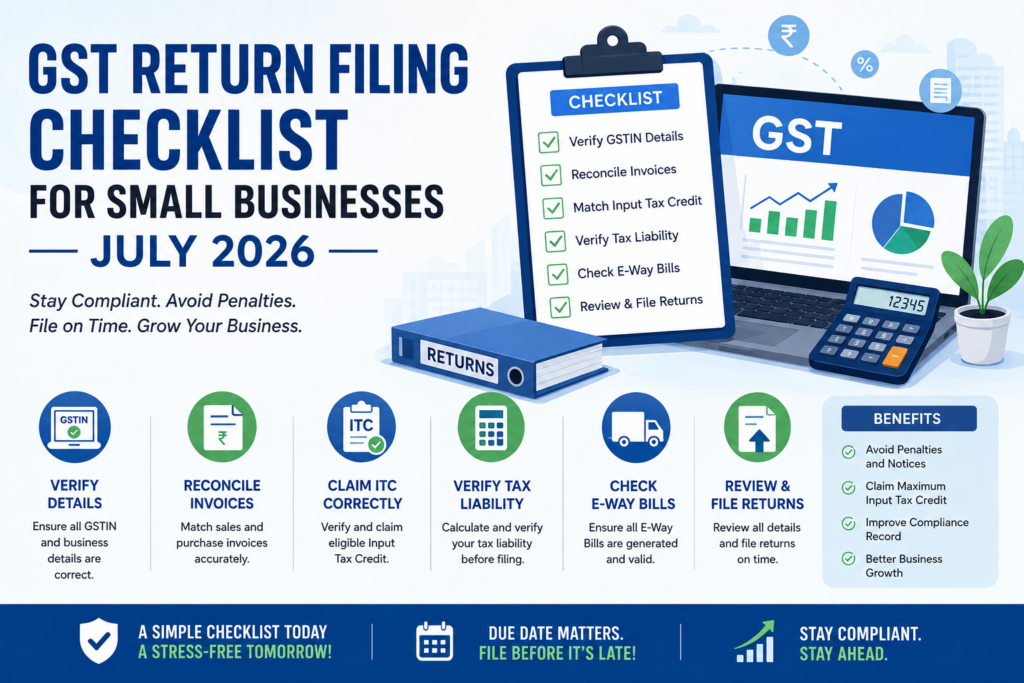
GST Return Filing Checklist for Small Businesses in July 2026
Filing GST returns accurately and on time is essential for every registered business in India. Whether you’re a startup, freelancer, trader, or MSME, following a GST Return Filing Checklist can help you avoid penalties, claim the correct Input Tax Credit (ITC), and ensure hassle-free compliance.
As GST regulations continue to evolve in 2026, businesses must stay updated with the latest compliance requirements. A single mistake in your GST return can lead to notices, blocked ITC, interest, or late fees.
This comprehensive GST Return Filing Checklist will help small businesses prepare, review, and file GST returns accurately for July 2026.
Table of Contents
Why Following a GST Return Filing Checklist Is Important
A proper GST Return Filing Checklist helps businesses:
- File returns accurately and on time
- Avoid GST notices and penalties
- Claim eligible Input Tax Credit (ITC)
- Maintain better compliance records
- Improve business credibility
- Reduce accounting errors
- Prepare for annual GST audits
Using a structured checklist every month ensures that your business remains compliant with GST laws while reducing financial risks.
GST Return Filing Checklist for July 2026
Follow this GST Return Filing Checklist before submitting your GST return.
1. Verify Your GST Registration Details
Before filing, ensure that your GST registration details are correct.
Check the following:
- GSTIN status
- Business name
- Principal place of business
- Email address
- Mobile number
- Authorized signatory details
Any outdated information should be updated through the GST portal.
Official GST Portal:
https://www.gst.gov.in/
2. Collect All Sales Invoices
Gather all tax invoices issued during July 2026.
Verify that every invoice includes:
- Invoice number
- Invoice date
- Customer GSTIN
- Place of supply
- Taxable value
- Applicable GST rate
- CGST, SGST or IGST
- HSN/SAC Code
Missing invoices often create turnover mismatches.
3. Reconcile Purchase Invoices
One of the most important steps in the GST Return Filing Checklist is purchase reconciliation.
Compare your purchase register with supplier invoices.
Check:
- GST amount
- Supplier GSTIN
- Invoice value
- Invoice date
- Eligible ITC
Reconciling purchases every month helps avoid future disputes.
4. Match Input Tax Credit (ITC)
Input Tax Credit is a significant benefit under GST, but incorrect claims can result in notices.
Compare your books with the auto-generated ITC available on the GST portal.
Verify:
- Eligible ITC
- Blocked ITC
- Reverse Charge transactions
- Capital goods
- Business expenses
Learn more about GST tutorials:
5. Verify Tax Liability
Before filing your return, calculate the total GST payable.
Cross-check:
- CGST
- SGST
- IGST
- Cess
Compare these figures with:
- Accounting software
- Sales register
- E-Invoices
- Financial reports
6. Review Reverse Charge Mechanism (RCM)
If your business is liable under Reverse Charge Mechanism (RCM), verify:
- RCM purchases
- GST paid under RCM
- Eligible ITC claimed
Incorrect reporting may attract penalties.
7. Check Debit Notes and Credit Notes
Ensure every adjustment made during the tax period is reflected correctly.
Review:
- Credit Notes
- Debit Notes
- Returned goods
- Discount adjustments
This keeps turnover and tax liability accurate.
8. Verify E-Way Bills
Businesses transporting goods should reconcile:
- E-Way Bills
- Delivery Challans
- Tax Invoices
- Dispatch Records
Official E-Way Bill Portal:
9. Verify E-Invoices
If your business falls under mandatory e-invoicing rules, verify:
- Invoice Reference Number (IRN)
- QR Code
- Invoice Amount
- GST Details
Official E-Invoice Portal:
10. Reconcile Business Turnover
Compare turnover reported in:
- Accounting Software
- GST Returns
- Bank Statements
- Sales Register
- Financial Statements
Differences should be resolved before filing.
11. Check HSN/SAC Codes
Using incorrect HSN or SAC codes may result in:
- Wrong GST rate
- GST notices
- Customer disputes
- Incorrect reporting
Always use updated HSN classifications.
12. Verify GST Rates
Review whether supplies are correctly classified as:
- Taxable
- Exempt
- Nil-rated
- Zero-rated
Latest GST notifications are available at:
13. Review B2B and B2C Transactions
Ensure proper classification.
B2B Supplies
- Correct GSTIN
- Invoice-wise reporting
- ITC eligibility
B2C Supplies
- State-wise reporting
- Correct tax rate
- Accurate taxable value
14. Pay Outstanding GST Liability
Before filing GSTR-3B:
- Check Electronic Cash Ledger
- Verify Electronic Credit Ledger
- Generate challan if required
- Pay pending tax
Payment can be made through:
15. File the Correct GST Return
Depending on your registration, file the appropriate return.
Examples include:
- GSTR-1
- GSTR-3B
- GSTR-4
- GSTR-5
- GSTR-6
- GSTR-7
- GSTR-8
- GSTR-9
Always verify due dates before submission.
Common GST Return Filing Mistakes
Even experienced business owners make mistakes.
Common errors include:
- Wrong GSTIN
- Duplicate invoices
- Missing invoices
- Incorrect ITC claims
- Wrong HSN codes
- Incorrect tax rates
- Late filing
- Mismatch between GSTR-1 and GSTR-3B
- Ignoring Reverse Charge transactions
- Incorrect turnover reporting
Following a proper GST Return Filing Checklist significantly reduces these errors.
Documents Required Before Filing GST Returns
Keep these documents ready:
- Sales Register
- Purchase Register
- Tax Invoices
- Credit Notes
- Debit Notes
- Bank Statements
- E-Way Bills
- E-Invoices
- Previous GST Returns
- Accounting Reports
Maintaining organized records simplifies return filing.
Benefits of Following a GST Return Filing Checklist
Using a GST Return Filing Checklist offers several advantages:
- Faster GST filing
- Improved compliance
- Reduced penalties
- Accurate ITC claims
- Better financial records
- Easier GST audits
- Improved cash flow management
Businesses that file returns regularly also build stronger financial credibility.
Penalties for Late GST Return Filing
Missing GST return deadlines can result in:
- Late filing fees
- Interest on unpaid tax
- Blocked Input Tax Credit
- GST notices
- Suspension of GST registration in serious cases
Timely filing is always more cost-effective than correcting errors later.
Best Practices for Small Businesses
To simplify GST compliance:
- Maintain digital accounting records.
- Reconcile invoices monthly.
- Verify supplier GST filings.
- Keep supporting documents organized.
- File returns before the due date.
- Review GST notifications regularly.
- Consult a GST professional for complex transactions.
A monthly GST Return Filing Checklist can save significant time and reduce compliance risks.
How Professional GST Filing Services Can Help
Many small businesses rely on tax professionals to manage GST compliance efficiently.
Professional services can assist with:
- GST registration
- Monthly GST return filing
- ITC reconciliation
- GST notices
- Annual GST returns
- GST audits
- Compliance advisory
Outsourcing GST compliance allows business owners to focus on growing their business while ensuring accurate filings.
Conclusion
A well-planned GST Return Filing Checklist is the key to timely and error-free GST compliance. By reviewing invoices, reconciling purchases, verifying ITC claims, and ensuring accurate tax reporting, small businesses can avoid penalties and maintain a strong compliance record.
As GST regulations continue to evolve, staying organized and filing returns on time is more important than ever. Make this GST Return Filing Checklist part of your monthly accounting routine to simplify compliance and protect your business from unnecessary tax issues.
External Sources: