
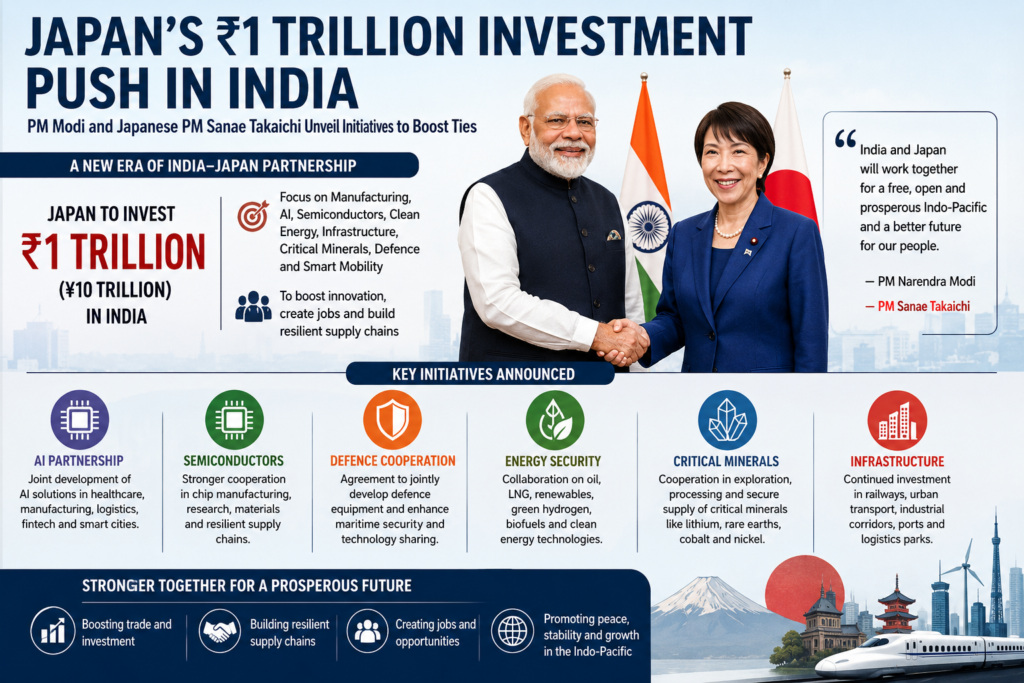
India and Japan have entered a new era of strategic partnership with one of the biggest investment announcements in recent years. During the 16th India-Japan Annual Summit held in New Delhi, Japanese Prime Minister Sanae Takaichi and Indian Prime Minister Narendra Modi unveiled an ambitious roadmap that includes a ₹1 trillion (¥10 trillion) Japanese investment commitment over the coming years.
Beyond the massive financial commitment, both nations signed multiple agreements covering artificial intelligence (AI), defence manufacturing, energy security, semiconductors, critical minerals, infrastructure, and supply chain resilience.
The announcement demonstrates the growing importance of India-Japan relations at a time when global economies are restructuring supply chains and investing heavily in technology-driven growth.
A Historic Investment Commitment
Japan’s commitment to invest ₹1 trillion in India marks one of the largest foreign investment initiatives announced by any country for India.
The investment is expected to focus on:
- Manufacturing
- Artificial Intelligence
- Semiconductor ecosystem
- Green energy
- Critical minerals
- Infrastructure development
- Smart mobility
- Defence manufacturing
This investment is designed not only to strengthen India’s economic growth but also to diversify Japanese manufacturing beyond traditional production bases.
According to officials, the investment roadmap aims to generate employment, encourage technology transfer, and create long-term industrial partnerships.
Source:
Why India Matters More Than Ever to Japan
Japan has been one of India’s most trusted strategic partners for decades.
Several factors make India increasingly attractive:
- World’s fastest-growing major economy
- Expanding digital economy
- Young workforce
- Growing manufacturing capabilities
- Stable policy environment
- Strong domestic market
As companies worldwide seek alternatives to concentrated manufacturing locations, India has emerged as a preferred destination for global investment.
Japan already supports several landmark Indian infrastructure projects including:
- Mumbai-Ahmedabad High-Speed Rail
- Delhi Metro
- Dedicated Freight Corridors
- Industrial Corridors
The new investment commitment significantly expands this relationship.
AI Partnership Takes Center Stage
Artificial Intelligence became one of the biggest themes of the summit.
India brings:
- World-class software talent
- AI startups
- Large digital public infrastructure
- Massive datasets
Japan contributes:
- Advanced robotics
- Precision manufacturing
- Semiconductor expertise
- Industrial automation
Together, both countries aim to develop AI solutions for:
- Healthcare
- Manufacturing
- Logistics
- Financial services
- Smart cities
- Government services
Industry experts believe the collaboration could create one of Asia’s strongest AI innovation ecosystems.
Additional Reading:
Reuters
Strengthening Semiconductor Supply Chains
Semiconductors have become one of the world’s most strategic industries.
The COVID-19 pandemic exposed vulnerabilities in global chip supply chains.
India and Japan agreed to deepen cooperation in:
- Chip manufacturing
- Research
- Supply chain resilience
- Component manufacturing
- Technology sharing
Japan remains a global leader in semiconductor equipment and specialty materials, while India is rapidly developing its semiconductor manufacturing ecosystem.
This partnership could help reduce dependence on concentrated global production centers.
Defence Cooperation Reaches a New Level
Perhaps the most significant strategic announcement was the decision to jointly develop defence equipment.
The agreement marks a major shift in India-Japan defence cooperation.
Areas expected to benefit include:
- Maritime security
- Naval communication systems
- Defence electronics
- Surveillance technologies
- Joint research
- Military innovation
Both nations also reaffirmed their commitment to a Free and Open Indo-Pacific, strengthening regional security cooperation.
Energy Security Becomes a Shared Priority
Global energy markets remain volatile due to geopolitical tensions.
India and Japan agreed to work together on:
- Oil supply resilience
- LNG cooperation
- Renewable energy
- Green hydrogen
- Biofuels
- Clean energy technologies
One notable announcement was the launch of a new cooperative initiative focused on clean energy and sustainable fuel development.
This collaboration supports both countries’ long-term carbon neutrality goals.
Critical Minerals: Preparing for the Future
Critical minerals such as:
- Lithium
- Rare earth elements
- Cobalt
- Nickel
are becoming increasingly important for:
- Electric vehicles
- Batteries
- Defence systems
- Electronics
- Renewable energy
India and Japan plan to strengthen cooperation in exploration, processing, and supply chain security.
Reducing dependence on limited global suppliers has become an important strategic objective for both governments.
Infrastructure Investment Will Continue
Japan has already financed several transformative infrastructure projects across India.
The new investment roadmap is expected to accelerate investments in:
- Railways
- Urban transportation
- Smart cities
- Industrial corridors
- Logistics parks
- Ports
Infrastructure remains one of the strongest pillars of India-Japan cooperation.
Economic Security Takes Priority
One of the summit’s biggest outcomes was the adoption of a new Economic Security Roadmap.
The roadmap focuses on protecting critical industries from future global disruptions.
Priority sectors include:
- Semiconductors
- Critical minerals
- Pharmaceuticals
- Digital infrastructure
- Telecommunications
- Artificial Intelligence
The objective is to build resilient supply chains capable of withstanding geopolitical shocks.
Trade Relationship Expected to Grow
India and Japan currently enjoy growing bilateral trade.
Both governments also agreed to review and modernize the existing Comprehensive Economic Partnership Agreement (CEPA).
Potential improvements include:
- Easier market access
- Faster customs procedures
- Digital trade
- Investment protection
- Services trade
- MSME cooperation
Business leaders expect this review to unlock significant new trade opportunities.
Opportunities for Indian Businesses
Japanese investment is expected to create opportunities across multiple sectors.
Industries likely to benefit include:
- Electronics manufacturing
- Auto components
- Renewable energy
- Defence production
- Software services
- Industrial automation
- Logistics
- Construction
Indian startups may also gain access to Japanese technology, funding, and international markets.
Employment Generation
Large-scale foreign investments typically generate employment through:
- Manufacturing plants
- Infrastructure projects
- Technology centers
- Supply chains
- Research facilities
Experts believe the investment could create thousands of direct and indirect jobs over the next decade.
Strategic Importance in the Indo-Pacific
India and Japan are both members of the Quad, alongside the United States and Australia.
Their growing partnership extends beyond economics.
Shared priorities include:
- Maritime security
- Freedom of navigation
- Secure supply chains
- Cybersecurity
- Disaster resilience
- Regional stability
The summit reaffirmed both countries’ commitment to maintaining peace and stability in the Indo-Pacific region.
Industry Reaction
Economists have welcomed the announcements as a major confidence boost for India’s investment climate.
Technology experts particularly praised:
- AI cooperation
- Semiconductor partnerships
- Manufacturing expansion
- Clean energy initiatives
Investors view Japan’s long-term commitment as a positive signal for international capital entering India.
Challenges Ahead
Despite the optimism, successful implementation will require:
- Faster project approvals
- Skilled workforce development
- Land acquisition reforms
- Strong policy coordination
- Efficient logistics
- Continued regulatory stability
Timely execution will determine how effectively both countries convert announcements into measurable economic outcomes.
The Road Ahead
The India-Japan partnership has steadily evolved from infrastructure cooperation to a comprehensive strategic alliance.
The latest summit demonstrates that both governments are now looking beyond traditional trade toward next-generation sectors such as:
- Artificial Intelligence
- Defence technology
- Clean energy
- Semiconductors
- Digital innovation
- Critical minerals
If implemented successfully, Japan’s ₹1 trillion investment could significantly strengthen India’s manufacturing ecosystem while helping Japan diversify its global economic partnerships.
As global supply chains continue to evolve, India and Japan appear well-positioned to become two of Asia’s most influential strategic and economic partners in the coming decade.
References
- Times of India – Japan’s ₹1 Trillion Investment Push in India
https://timesofindia.indiatimes.com/business/india-business/japans-rs-1-trillion-investment-push-in-india-pm-modi-and-japanese-pm-sanae-takaichi-unveil-initiatives-to-boost-ties/articleshow/132140833.cms - Reuters – India and Japan Sign AI, Defence and Energy Agreements
https://www.reuters.com/world/asia-pacific/india-japan-sign-pacts-boost-cooperation-ai-metals-energy-2026-07-02/ - Economic Times – India-Japan Summit Roadmap
https://m.economictimes.com/news/economy/foreign-trade/india-japan-summit-bonhomie-meets-business-as-modi-takaichi-deepen-bilateral-partnership/articleshow/132132601.cms - Embassy of India in Tokyo – India-Japan Bilateral Brief
https://www.indembassy-tokyo.gov.in/eoityo_pages/MTE%2C